|
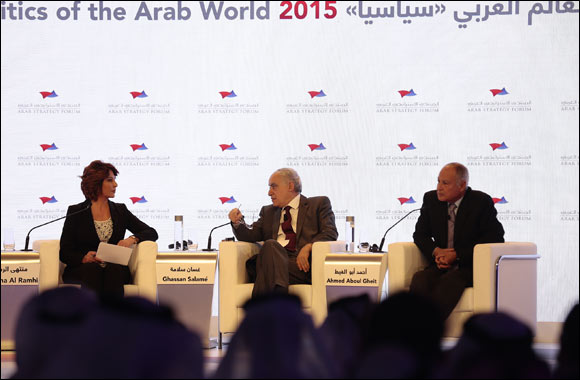
Dubai-UAE: 14 December, 2014 – The fifth session of the Arab Strategy Forum hosted Ghassan Salame, the former Lebanese minister, as well as Ahmad Abou El Ghaith, former foreign minister of Egypt. Ghasan Salame opened his speech with a quote of Henry Kissinger: ‘There’s nothing new in the foreign policy, what needs to be new is the analysis.’
Salame added: “There is a trend that begun years ago and will continue: globalization of the economy and the localization of policy. We will see more of a localization of policy as we will see higher impact of the region’s countries and a lower impact of international powers. During the past few years, the impact of UAE and Suadi Arabia was considerably larger than that of the US in a number of regional issues. “The second trend is that there is a significant impact of the oil markets and revenues on politics. We are facing a new phase and if the oil reaches lower prices, we will see a large number of countries that spent part of their surplus on conflicts across the world, reducing their expenditure on these conflicts. “Spending on the Syrian crisis has fallen, the support to ISIS and other groups dropped. This decline in support will reduce the intensity of conflict. “In 2015, there are many occasions that might change the status: there are important dates in 2015: 1 March is the date set to reach an agreement on the Iran nuclear issue, there is also the date of the Israeli elections and the Turkish elections. “On the Iranian-American agreement, I think there’s a greater opportunity to reach an agreement in 2015. The outcome of this possible agreement has already begun to show and we all know the important role of Iran in the region. “What was called “Arab spring” will take different lanes. “Nothing is left for fate in 2015. The situation will depend on three factors:
1- calculations: the past years have proven that a number of the region's leaders miscalculated
2- capacities: the existence of capacity is an important factor. At least these capabilities will be less in 2015, especially the financial abilities
3- will: Capacity alone is not enough if not associated with the will to employ them. Commenting on his participation in the Arab Strategy Forum, the former Egyptian foreign minister Ahmed Abu Ghaith said: “2015 will be a continuity of 2014 and the vision of 2015 will be an extension of the events we witnessed this year. Honestly, it is a bit difficult to foresee the region’s situation in 2015 as the Arab world and the countries of the region are unable to realise what’s going on. I think 2014 has set the stage for 2015 and this means that the situation will not change positively as we all we wish. “There are some facts we can look at to assess the future situations. The first one is that many of the main power in the Arab region have been destroyed. Syria is facing an unknown fate, Iraq is witnessing a complicated situation and Libya is on the edge. The second fact is the huge wave of hypocrites who hide behind their fake Islam to provoke revolution and are invading the region with extremist ideologies: ISIS, Muslim brotherhood, Al Nosra and al Qaeda. “Another fact to bear in mind is that Iran is close to reaching an agreement with the West, and this would give it the clout to emerge outside its borders as if they achieved the impossible. And even if the dialogue fails, Iran will also try to impose its hegemony on the region under the pretext of protecting it from western powers.” On international issues, the former Egyptian foreign minister commented: "There are signs of the return of Cold War between Russia and the United States because of Ukraine. Russia wants to affirm its position now, and we'll see whether they will strike a deal in Ukraine in exchange for a deal in Syria. The Palestinian issue has been and will always be a key issue for the Arab world and I do not predict any real progress in this front regardless of the outcome of the Israeli parliamentary elections, because to the Israelis, their view is why should give the Palestinians any rights or privileges. " On the regional role of some of the Gulf States in supporting the current Egyptian leadership Aboul Ghaith said: "Over the next year, we will see a continuation of the current regional policy actors of the UAE and Saudi Arabia. The impact of this regional support is required to stabilize Egypt, and I believe that the Egyptian state, the Egyptian people, and the Egyptian armed forces have triumphed pending the final defeat of terrorists and the end of the war on terror. The question is when we will achieve final stability in Egypt to start again." On the most pressing regional issues, Aboul Ghaith said: "The consequences of what happened in Egypt will remain for several years. Iraq will continue its war on ISIS. We also must be careful not to allow the so-called Islamists to spread a discourse of division and portray the situation today as if it is crusade against Islam and Muslims. “As far as Syria is concerned, the current situation will remain in place with the real possibility of ISIS flocking back to Syria in case they are expelled from Iraq which is why we need to find a political solution in Syria. But I do not think that this will happen in 2015 except if there is a change in strategy in handling the Syrian situation. Finally, in Libya, I don’t think we will see major progress there during the next year and there is a good chance that it will break into smaller states unless the state restores its control over most of the territories without foreign intervention.”
|  RSS Feed