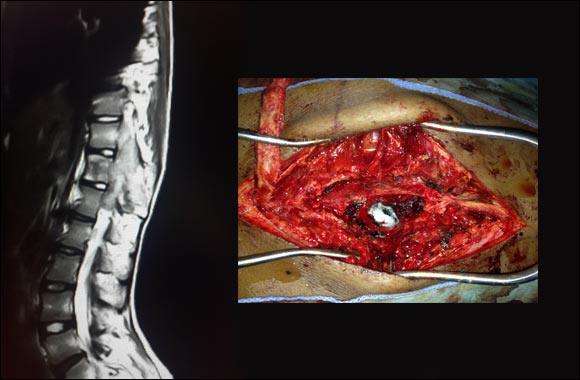
Parents ecstatic as sensations return within just 24 hours of surgery November 30, 2014: RAK, UAE: 4 year old Lateefat flew all the way from Nigeria to UAE in the hope of some relief from her devastating condition. A complete paraplegic with no sensations, reflexes or movements below the waist, her situation had put her life into a complete standstill. A biopsy had identified a benign tumor within the vertebral column, of a kind so rare that only a handful of children in a year are affected worldwide. No specialist in Nigeria would touch it, the surgery was too risky. Abnormal tissue growths within or next to the spinal cord, called spinal cord tumors, are uncommon and those arising from the vertebral column particularly rare. Whether they are malignant (cancerous) or benign (non-cancerous), they can cause serious neurological deficits because as they grow the spinal cord becomes compromised. Spinal tumors or growths of any kind can lead to pain, neurological symptoms and sometimes, paralysis. Whether cancerous or not, a spinal tumor and its consequences can be life-threatening and cause permanent disability. Narrating the incident, Dr. Hillol Kanti Pal, HOD, Neurosurgery and Spine Center at RAK Hospital, Ras Al Khaimah, said, “On my recent trip to Lagos, Nigeria I was shown a report of the MRI Scan of this 14 year old girl. There was no film of the images. Not knowing what the neurological status of the patient was, and noticing that it was of a girl 14 years old, I said, ‘Yes, I will operate’. I knew the surgery was risky but I took the challenge as I was confident of our team at RAK Hospital and knew we could help. The girl’s mother and family was totally devastated with her daughter’s condition. The only thing she wanted for her daughter was to see her move her legs again otherwise life would be nothing for the young girl. The family flew to RAK with our assurance and today I can proudly say they left home with smiles and renewed health. I went to see the girl exactly after 24 hours of surgery; the movements and accompanying sensations had returned and were improving by the hour”. “Spinal cord tumors in children are very rare, but they do happen. This potentially serious medical condition can be life threatening if left untreated. Prompt diagnosis and treatment are necessary to prevent these deficits from becoming permanent. Due to the girl’s frail condition, the surgical decision making was fraught with many uncertainties, in particular the use of spinal instrumentation to stabilize the spine after tumor resection. However we did it with complete precision and it gives me immense pleasure to claim that we are completely equipped to handle such extreme cases. It’s becoming evident time and again that UAE is turning into the newest destination for medical tourism with such advances in surgical prowess. Tumor had to be removed without compromising the stability of the spine as instability resulting from overenthusiastic bone removal may have destabilized the spinal column leading to pain or worsening her neurological status. Some complications either during surgery or postoperatively can even be fatal”, added Dr. Pal. Expressing gratitude and thanking the team at RAK Hospital, mother of the teenage girl said, “We had lost all hopes but now we are ecstatic to see our young girl reviving, it’s a great feeling. This is what I came for all the way from Nigeria and I am glad I took the decision to come here. I am hoping to see my daughter back on her feet soon”. Symptoms of a spinal cord tumor: Because spinal cord tumors grow slowly over time, symptoms tend to develop over months. Symptoms also vary from patient to patient, and can include the following: - Chronic neck or back pain - This is the most common symptom. The pain can either be very localized or radiating. Some children do not show any symptoms until they experience a minor injury, like a sports accident. If a child complains of chronic back pain that does not resolve itself or worsens, he/she should be examined and evaluated quickly.
- Vague or nonspecific complaints — Some infants and young children can complain of seemingly unrelated pain, like abdominal pain. These children often undergo extensive evaluations of the unrelated area before a spinal cord tumor is ultimately identified.
- Specific neurological complaints — As the tumors expand and create compression within the spinal cord, normal neurological function is impacted. These symptoms are sometimes confused with “growth pains.” These specific symptoms can include:
- Decreased motor skills such as walking, balancing, sitting straight etc.
- Muscle weakness, which can progress to paralysis without prompt intervention
- Loss of sensation or numbness
- Pure sensory dysfunction, although this is very rare
- Loss of bowel or bladder control
- Spinal deformity — Scoliosis occurs in up to one third of children with spinal cord tumors
How is a spinal cord tumor diagnosed? Symptoms can be difficult to identify in children so regular check-ups with a pediatrician are extremely important. To ensure a timely diagnosis, a child’s pediatrician should be consulted as soon as any of the symptoms or neurological deficits outlined above display themselves. With proper diagnosis and treatment, these tumors can be managed and successfully treated. A diagnostic evaluation begins with a thorough medical history and physical examination. A detailed neurological assessment is also performed. Several diagnostic tests will be run, and can include: - Radiological imaging studies — to identify the location and appearance of the tumor.
MRI (magnetic resonance imaging) is the most helpful diagnostic tool. Using intravenous contrast agents, a physician can view the tumor’s structure, exact location and size in relation to the spinal cord. Computed tomography (CT) scans help the physician look for tumor lesions in other areas of the body. If the spine tumor is believed to arise from outside the spinal cord, this is an important tool. 2. Biopsy — from the actual tumor in order to provide a precise histopathological classification.
|

 RSS Feed


