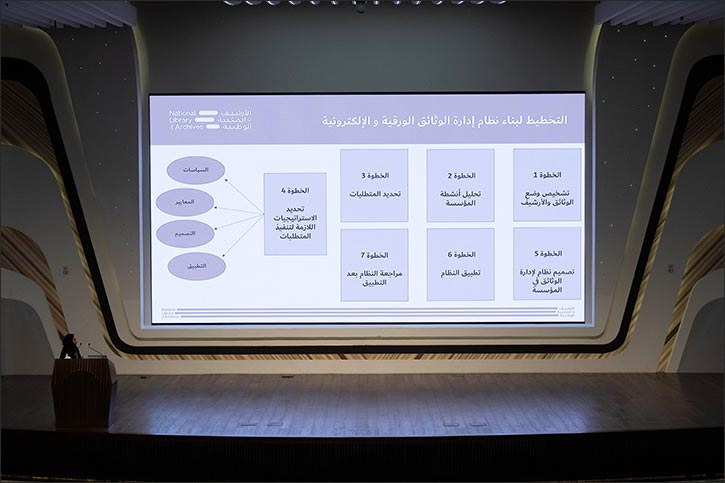
Dubai, UAE, 10 December 2025: In collaboration with the National Library and Archives, the Mohammed Bin Rashid Library organised a workshop titled The Importance of Organising and Managing Records and Archives in Government Organisations. The workshop was attended by experts and specialists in archiving and document management. The workshop aimed to develop archiving practices within government organisations, thereby contributing to improved efficiency in document management and the comprehensive preservation of national heritage, according to the highest international standards. In his opening remarks, Dr. Mohammed Salem AlMazrooei, Board Member at Mohammed Bin Rashid Al Maktoum Library Foundation, said: “Organising and hosting this workshop at the Mohammed Bin Rashid Library supports our belief that archiving and document management are an essential part of the modern governance system. Meeting under the umbrella of this cultural edifice gives us an opportunity to raise awareness on the importance of building an integrated national archive, exchange experiences with government organisations, and develop practices that preserve institutional memory and support knowledge sustainability.” AlMazrooei added: “This workshop marks a strategic step towards developing a vital sector that affects the quality of government performance, and the preservation of the UAE’s cultural and intellectual heritage.” His Excellency Dr. Abdulla Majid Al Ali, Director-General of the National Library and Archives, said: “This workshop addressed a key topic that constitutes a pivotal point in preserving organisational memory. It plays a fundamental role in enhancing efficiency, supporting the decision-making process, and protecting the rights of individuals and entities, in addition to reinforcing the principles of good governance and promoting transparency. With the rapid development of modern technologies, namely artificial intelligence and its applications, workshops like these have become critical as they facilitate access to information and pave the way for more accurate and effective organisational processes.” Al Ali continued: “Organising and managing documents in government archives presents a growing challenge given the enormous and ever-increasing volume of data. At the National Library and Archives, we strive to develop solutions to process this data, analyse its content, and make it accessible according to the latest international standards.” Al Ali expressed confidence in the capabilities and expertise of national cadres, and in the technical and technological skills they possess that qualify them to develop advanced systems for managing and preserving documents and records. He explained that, through this initiative, future generations will witness the UAE’s successful journey and its outstanding achievements, and highlighted that the National Library and Archives is ready to offer advice and technical and technological support. The workshop featured multiple lectures, including a comprehensive presentation by Dr. Hamad Al Mutairi, Acting Executive Director of the National Library and Archives. The presentation discussed legislation and standards adopted for managing documents and archives, with a focus on global practices and major laws that ensure the safe and reliable organisation and preservation of documents. Furthermore, Professor Amal Abdel Hamid reviewed managing current and intermediate documents and technical procedures, explaining the steps for organising daily documents in a way that ensures accuracy and ease of access to them. Meanwhile, Dr. Sufian Bouhrat addressed the management of e-documents, and shed light on modern technical solutions for preserving digital documents and ensuring their easy retrieval. The workshop ended with an interactive discussion session, providing participants with the opportunity to ask questions and discuss challenges and opportunities in archiving and document management. Time was also allocated for refreshments and networking, facilitating the exchange of experiences and knowledge and opening avenues for collaboration among government organisations, thus contributing to building an integrated knowledge society that enhances the efficiency of institutional work. |  RSS Feed