|
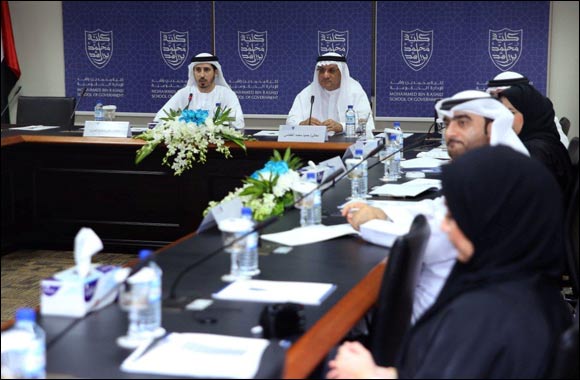
Session Titled: ‘Building National Leadership, a Journey of Achievements and Chances for Development’ Al Qatami: Building leadership capabilities is a cornerstone that supports the development process of the UAE Dubai-UAE:30 June, 2014 - Mohammed Bin Rashid School of Government (MBRSG), a research and teaching institution focusing on public policy in the Arab world, today organized the second session of the Knowledge and Policy Council titled‘Building National Leadership, a Journey of Achievements and Chances for Development’. The session saw representatives from various leadership building programs in the UAE discussing methodologies for developing Emirati leadership andthe imperative need to work synergistically for achieving the objective. The participants also reviewed the leadership building programscurrently underway in the UAE, their strengths, best practices and potential areas of improvement. Solutions for enhancing the commitment of institutions and individuals engagedin leadership programs were also explored during the session. Chaired by His ExcellencyHumaid Al Qatami, Minister of Education, Chairman of the Federal Authority for Government Human Resources,the session drew the participationofDr Ali Sebaa Al Marri, Executive President of MBRSG,Obaid Al Kutbi, Manager, UAE Government Leaders Program,Ibtisam Bin Balila, Coordinator General, Mohammed Bin Rashid Leaders Program, Faisal Al Noaimi, Chairman, Higher Committee, Abdulaziz Bin Humaid Leaders Program,Jasim Mohammad Al Bloushi, Chairman of Sharjah Development Forum/Sharjah Leaders Program,LtDr. Omar Al Ali, Deputy Manager, Leaders Development Center, Ministry of Interior, andSultan Al Dhaheri, Director of Registration, Excellence Center, General Secretariat, Abu Dhabi Executive Council. His ExcellencyHumaid Al Qatami said: “The federal government seeks to continuously develop national leaders who hold the potential to be on top of current events and developments. This drive is part of the federal government’sHR strategy that aims to enhance national competenciesand skills.Building leadership capabilities is a cornerstone that supports the development process of the UAE and is also a main pillar of the UAE Vision 2021.A strong rank of leaders will play a strategic rolein enhancing our global competitiveness and position us among the developed nations. “Towards this end, establishing cooperation with other stakeholderswho share this objective is essential. The Knowledge and Policy Council offers the opportunity to articulateour understanding and experience, and take us a step closer to achieving our goals.” Dr Ali Sebaa said: “Our wise leadership, seeks to build an advanced Emirati society and individuals. It is to their credit thatthe leaders have achieved great success in their objective. Continuing the journey, our leadership is focusing on developing their people to secure the UAE’s future. “On our part, we are keen to support this mandate. We recognize that becoming competent leaders needsa combination ofknowledge, skills and experience. Through the Council, we seek to bring together successful leaders to deliberate and transfer their knowledge and expertise. The process is documented to create areference for current and future leaders.” As part of the Council’s focus areas, the participants reviewed opportunities to develop the effectiveness and sustainability of leadership programs and enhance their efficiency. The need to expand leadership programs to include UAE citizens working in the private sector to reinforce the participation of nationals in the sector was also examined. The Council additionally explored the need for coordination among various programs in sharing knowledge and expertise to boost their efficiency and align their outcomes. Participants agreed on the importance of establishing an umbrella bodyto facilitatethis coordination and providesupport to graduates in addition to developing criteria that help build the credibility of such programs without limiting them or affecting their unique offerings. The Knowledge and Policy Council provides insights and recommendations intoareas that impact the cooperation and development of government performance, while enhancing personal and institutional communication to facilitate intra-governmental relations. The Council is also mandated to highlight priority issues and public policy matters that are relevant to the community and the government. MBRSG had designedthe Council asan integrated action agenda to ensure a comprehensive and in-depth analysis of the issues raised. The sessions are documented to optimize the benefit of the outputs and recommendations for research and training at MBRSG, and publication on the official website and social media platforms. The outcomes of the sessions are also compiled in a research paper that will be published. The Mohammed Bin Rashid School of Government is committed to promoting good governance through enhancing the region’s capacity for effective public policy. The school uses a four-pronged approach, which includes applied research in public policy and management, academic programs in public policy and administration, executive educations programs and knowledge forums for scholars and policy makers.
|  RSS Feed