|
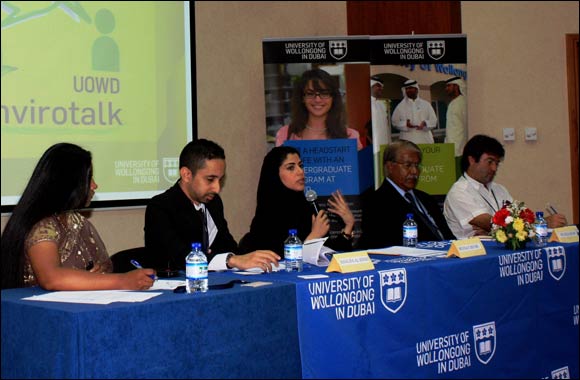
Dubai, March 18, 2014: A panel of leading experts in environmental sustainability discussed the growing challenges of urbanisation and population growth at the first annual EnviroTalk, hosted by the University of Wollongong in Dubai (UOWD) as part of its mission to provide a platform for discussion on critical topics relevant to both students and the wider community. Representing different dimensions of the environmental movement, the panel consisted of Dr Jacky Judas, Research Manager, Wadi Wurayah National Park; Mr Khalid Al Kindi, Head of CSR, Emirates NBD; Ms Meera Taryam, Director of Environmental Services and Education, Bee'ah, Sharjah; and Dr Mohammad Ali Reza Khan, Specialist - Wildlife and Zoo Management, Dubai Municipality. Among the issues debated was the challenge of waste management in the context of the country's growing population. With the average resident producing 2.5kg of waste each day, the UAE compares unfavourably to many countries. However, as Ms Taryam revealed, around 60% of this waste is recyclable, and initiatives are being developed to achieve this. Ms Taryam said, "Our goal in Sharjah is to achieve zero waste to landfill. Through intensive recycling, education and awareness programs we have achieved 67% diversion to date, and by 2015 we aim to be diverting all waste away from landfill sites, which will provide economic as well as environmental benefits." Animal conservation was also highlighted as a major challenge, as urbanization threatens to fragment natural habitats. Dr Judas explained how the protection of Wadi Wurayah National Park has led to the preservation of natural ecosystems that have revealed 737 species, of which 63 are entirely new to science. Dr Reza Khan discussed the captive breeding programs that have preserved native species, such as the Arabia Oryx, and stressed the importance of zoos as a gene bank for the continuity of the animal world. He also discussed Dubai's strategy for a 'green belt', to protect the natural environment and its wildlife. While underling the importance of the corporate world in environmental sustainability, Mr Al Kindi said, "A significant proportion of the world's largest economic entities are now corporations, not countries. This means that it is the companies that are the drivers of change in this field. Governments can guide and facilitate, but it is businesses that will lead change." Mr Al Kindi listed some of the initiatives implemented by Emirates NDB as part of its CSR strategy. Ms Zeenath Reza Khan, an Instructor at UOWD's Faculty of Engineering and Information Sciences and organizer-cum-moderator of this year's event, said, "We believe in student-centred learning environments, at the same time guiding them to discover concepts and their applications through practical, hands-on experiences. Creating such a platform was indeed very fruitful for our students as they came away with greater understanding of the impact of urbanisation on the local environment and the critical part we play."
|  RSS Feed