
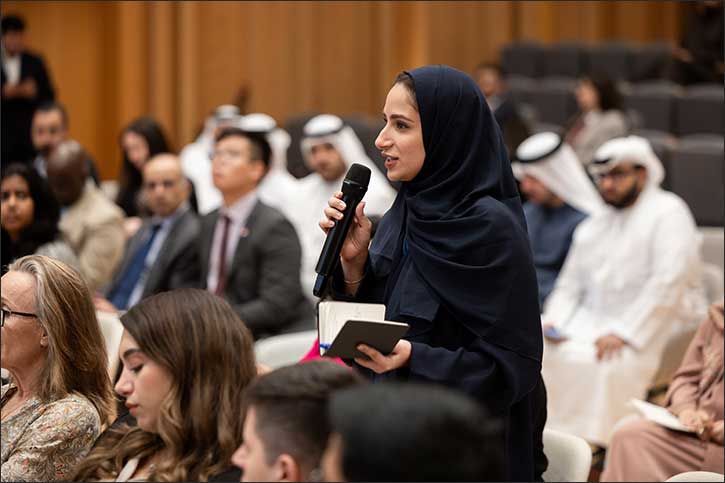
Abu Dhabi, UAE, 22 January 2026: In cooperation with the Anwar Gargash Diplomatic Academy, the Abrahamic Family House Center organised a panel discussion titled “Can Interfaith Diplomacy Redefine Global Peace and Cooperation?”. The session explored the role of interfaith diplomacy in fostering mutual understanding, building social cohesion, and strengthening international cooperation, while highlighting the UAE’s leadership in promoting tolerance and coexistence. The session saw a large turnout and wide participation from ambassadors, diplomats, and faculty members of the Academy,
The event began with a keynote address by His Excellency Dr. Ali Rashid Al Nuaimi, Chairman of the Committee on Defence, Interior, and Foreign Affairs in the Federal National Council (FNC). In his speech, Al Nuaimi stressed that the misuse of religion as a tool to divide people is one of the most dangerous challenges facing the world today. However, he affirmed the belief that leaders—especially religious leaders—possess a unique ability to build bridges of communication rather than barriers.
Al Nuaimi said: “Experience has shown that great human values are present in all religions, and that engaging religious leaders in genuine dialogue can enhance trust, dismantle the causes of conflict, and build a future based on respect and equality among all people.”
Moderated by Professor Joel Hayward, Senior Research Fellow at the Anwar Gargash Diplomatic Academy and the Abrahamic Family House, the session featured His Excellency Dr. Mohammed Ibrahim Al Dhaheri, Deputy Director-General of the Anwar Gargash Diplomatic Academy, and Dr. Ebtesam Al-Ketbi, President and Founder of the Emirates Policy Center. The discussion addressed the role of interfaith dialogue as an effective tool for promoting peaceful coexistence and building bridges of trust between communities.
The session highlighted the importance of engaging religious leaders in conflict prevention. It also showcased the UAE’s experience, particularly the Abrahamic Family House Center as a model for tolerance and social integration—and emphasized shared human values as a foundation for stability, along with the need to turn dialogue into tangible and sustainable outcomes for peace and development.
Al Dhaheri said: “The UAE’s leadership in peaceful coexistence is not a promotional narrative or a temporary diplomatic instrument; rather, it is a foundational choice in the building of the state, where tolerance forms an integral part of the social fabric. This cohesive internal model is what has given the UAE global diplomatic credibility and a unique ability to communicate with all parties.”
Al Dhaheri continued: “The success of interfaith dialogue diplomacy is linked to continuity and to practicing it as a daily approach that begins with education, becomes embedded in culture, and is reflected in policies—away from short-term political instrumentalisation. The Abrahamic Family House Centre is a living model of interfaith cooperation as it reflects the values of tolerance and coexistence, which constitute two fundamental pillars of the UAE.”
On the other hand, Al-Ketbi said: “Interfaith engagement works as a preventive tool for reducing conflicts by expanding the circle of trusted actors, especially in fragile environments, where religious leaders possess social legitimacy and a real ability to calm tensions and confront and expose rumors.”
Furthermore, Hayward said: “In the UAE, interfaith dialogue has been a deeply rooted approach since the late Sheikh Zayed bin Sultan Al Nahyan, who viewed diversity as a divine will that enables people to know one another and stand together. Under the leadership of His Highness Sheikh Mohamed bin Zayed Al Nahyan, the UAE reaffirmed its commitment to guaranteeing the rights of all who live in the country, regardless of their religion, ensuring their freedom of expression and sense of belonging to the nation in a safe and respectful environment.”
He continued: “Today, the UAE stands at the forefront of global interfaith dialogue—not as a slogan, but as a public policy and a way of life. This was powerfully exemplified in the historic meeting between His Eminence Dr. Ahmed Al-Tayeb, Grand Imam of Al-Azhar, and His Holiness the late Pope Francis, Former Head of the Catholic Church—a landmark moment that could not have taken place anywhere else.”
Hayward highlighted that the UAE is home to mosques, churches, and temples, where people worship in safety, dignity, and mutual respect—representing a rare model of genuine religious coexistence, exemplified by the Abrahamic Family House Centre.
The event witnessed wide participation and strong interaction from students and faculty at the Academy, in addition to ambassadors from several countries, reflecting international and local interest in peaceful coexistence and interfaith dialogue. This underscores the UAE’s success in promoting its unique model as a foundation for global peace and understanding.
The Abrahamic Family House Centre is committed to organising events that reflect its mission of promoting understanding and coexistence among religions and cultures, building bridges of communication between communities, and providing a platform for the exchange of ideas—ensuring that dialogue is transformed into tangible impact and practical initiatives that enhance coexistence and cooperation.