- Year-long initiative will embed AI across learning, research and campus life
- The programme aims to develop graduates fluent in AI, critical thinking and ethical judgement, supporting the UAE's vision for responsible, human-centered innovation
- Launched following the successful conclusion of Marine AI and Robotics for Innovation and Sustainability (MARIS-AI) Symposium
United Arab Emirates- Abu Dhabi, 22 January 2026 – Sorbonne University Abu Dhabi (SUAD), has officially declared 2026 as its 'Year of AI,' marking a major institutional commitment to embedding Artificial Intelligence (AI) across education, research and public engagement. Guided by the slogan, "Choose AI, Choose Critical Thinking," the initiative positions AI as a tool to enhance learning while strengthening human reasoning, creativity and ethical awareness.
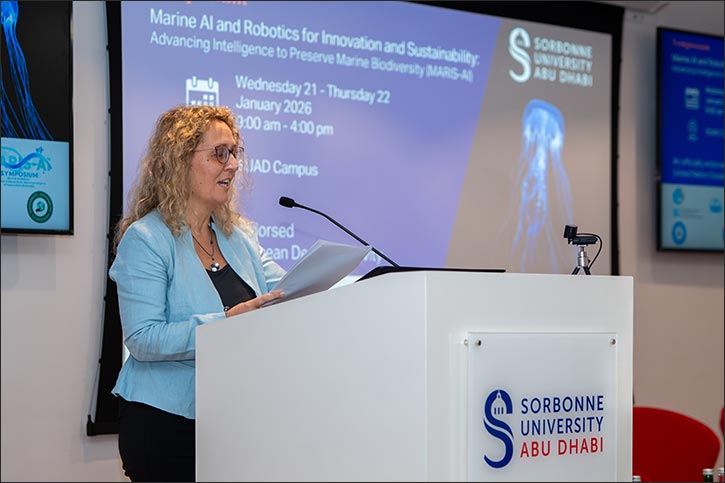
The announcement was made at the conclusion of the international MARIS-AI Symposium (Marine AI and Robotics for Innovation and Sustainability: Advancing Intelligence to Preserve Marine Biodiversity), held on January 21st and 22nd at the SUAD campus. The event offered a powerful launch platform by demonstrating how AI and robotics are already transforming marine science, sustainability and environmental protection.
Commenting on the milestone, Prof. Nathalie Martial-Braz, Chancellor at Sorbonne University Abu Dhabi, said:"By making AI the core theme of our Year of AI, Sorbonne University Abu Dhabi embodies a uniquely techno-humanist and holistic vision: combining the excellence of the French academic tradition with the UAE's forward-looking ambition to accelerate both research and education. Our purpose is clear—to educate citizens who are not only fluent in AI, but capable of rigorous reasoning, ethical discernment and creativity; to keep human oversight and critical thinking at the center of every use; and to turn AI from a black box into a tool that strengthens responsible, informed decision-making for the common good"
"We launched the Year of AI through MARIS-AI to show AI at its most meaningful, advancing science, sustainability and proving that this intelligent system is not abstract, but a powerful tool for solving humanity's most urgent challenges."
MARIS-AI, an officially endorsed United Nation Ocean Decade Activity, brought together academics, industry experts, policymakers and students from around the world. Leading speakers included Dr. Giulia De Masi, Associate Professor at SUAD; Dr. Francesco Maurelli, Associate Professor of Marine Systems at Constructor University, Germany; Dr. Beatriz Garcia, the Spokesperson for Sustainability and Associate Professor at SUAD, under the leadership of Professor Gérard Biau, Director at SCAI. International experts from institutions such as Hong Kong University of Science and Technology, Khalifa University, MBZUAI, NYU Abu Dhabi and the Italian National Research Council also presented advanced work on ocean sensing, underwater navigation, robotic swarms and soft robotics.
The symposium showed how AI-driven technologies such as autonomous underwater vehicles, machine learning models and edge AI are transforming ocean monitoring, enabling more accurate data, early warning systems and better protection of marine biodiversity. A panel on sustainability and data governance highlighted the need for responsible frameworks to match technological progress.
MARIS-AI concluded with strong outcomes, including new academic and industry collaborations and shared visions for responsible use of intelligent systems. Its success provided a powerful foundation for launching the Year of AI.
The Year of AI reflects both SUAD's academic vision and the UAE's national direction, including the National AI Strategy 2031 and the country's commitment to ethical, secure and human-centered AI. Through this initiative, SUAD aims to support the UAE's ambition to be a global leader in artificial intelligence through education, research and international collaboration.
Throughout 2026, the University will deliver a year-long program of academic and public activities, including major conferences such as the AI SUAD Summit 2026 in April, interdisciplinary forums, research events and public lectures bringing together experts in science, health, law, ethics, humanities and technology. Activities led by the Sorbonne Center for Artificial Intelligence (SCAI) will further connect researchers and students through workshops, open sessions and thematic visits across departments.
Across campus, the Year of AI will showcase ongoing initiatives- from AI library tools and the NORA chatbot developed by the FLE (French as a Foreign Language) Department, to AI-supported teaching, staff training programmes, and school outreach. All activities will be centralised to present SUAD's AI-driven university vision and made accessible to students, partners and the wider public. At its core is SUAD's commitment to equipping students with the critical skills to use AI responsibly — recognising that while AI can generate answers, students must learn the reasoning and process that lead to them.
This vision is reflected in the Year of AI visual identity, symbolised by a human hand and a robotic hand working together, reflecting that critical thinking and human intelligence are indispensable to harness technology and AI effectively.
By declaring 2026 as the Year of AI, Sorbonne University Abu Dhabi strengthens its position as a regional catalyst for responsible innovation, uniting artificial intelligence, sustainability and critical thinking to shape future-ready generations for a rapidly evolving world.