Dubai. Roads and Transport Authority. 15th March 2026:
Dubai’s Roads and Transport Authority (RTA) has secured prestigious international certifications in resilience, information security, and asset and technology management, recognising its efforts to deliver high-value transport and infrastructure services of outstanding quality.
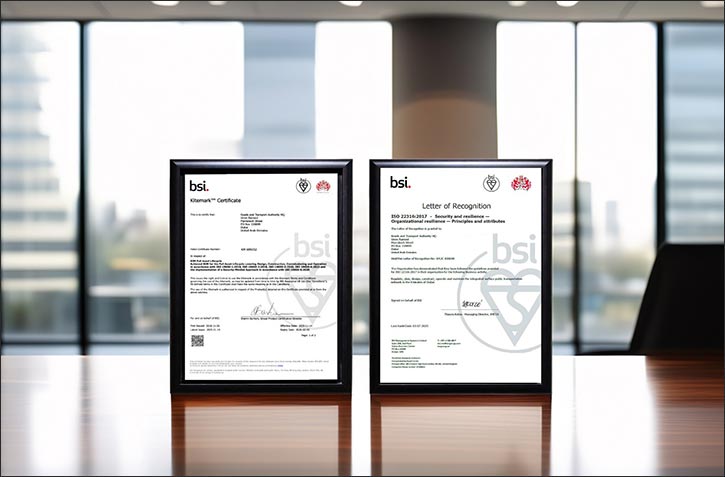
The achievement was realised through dedicated institutional efforts that led to obtaining the ISO 22316 certification for Organisational Resilience. This certification reflects RTA’s strong capability to manage crises and unexpected developments through the establishment of an integrated management system that enhances institutional resilience to potential challenges, ensures rapid and effective crisis response, and supports business continuity and long-term sustainable growth.
The importance of this international standard lies in providing a comprehensive framework that enables organisations to strengthen their ability to proactively plan for risks, adapt swiftly to emergencies, recover and continue to grow, while drawing lessons that enhance performance and institutional excellence. This, in turn, strengthens public confidence and reinforces RTA’s reputation at all levels.
RTA is the first transport entity in the Middle East and North Africa to obtain this certification, adding a new achievement to its record of innovation and leadership in transport and governance.
In addition, the RTA obtained the ISO 19650 certification in all its parts (1–5) for the implementation of Building Information Modelling (BIM). According to documentation by the British Standards Institution (BSI), RTA has become the first entity worldwide to obtain this certification covering all parts of the standard, which focuses on managing asset information across the full asset lifecycle. The achievement reflects RTA’s commitment to adopting global best practices in managing information related to infrastructure and asset projects.
The certification covers all stages of the asset lifecycle, from planning and design to implementation, operation and maintenance, and ultimately rehabilitation or decommissioning. This contributes to improving project management efficiency, sustainability, safety, and the quality of decision-making.
The achievement also supports the adoption of advanced technologies such as digital twin applications and smart city solutions. Building Information Modelling (BIM) represents an integrated digital ecosystem based on data-rich three-dimensional models that enhance the management of engineering projects, improve coordination, and reduce time, risks and costs throughout the project lifecycle. The certification was granted following rigorous audit processes, making it a reliable indicator of the quality of systems and procedures applied in managing assets and projects.