
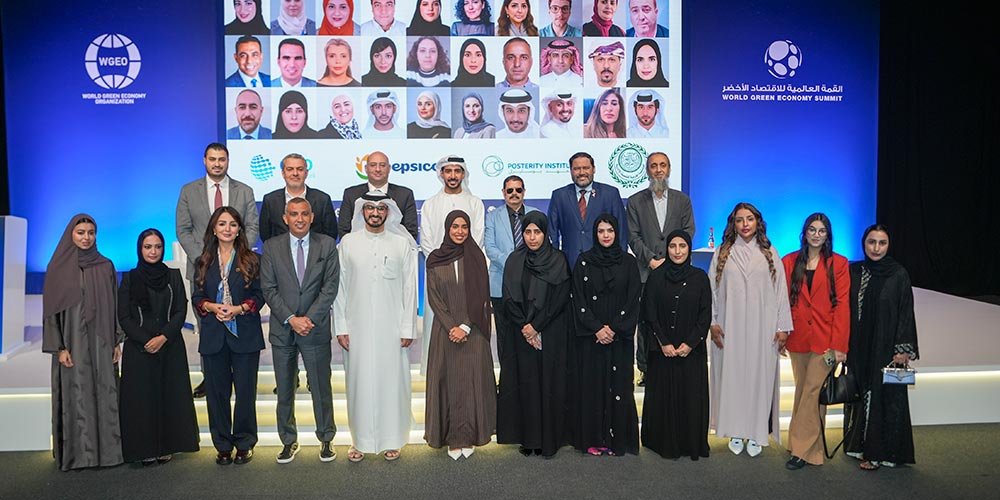
Growing fellowship equips government officials with practical skills to embed sustainability in decision-making
Dubai, United Arab Emirates, 26 October 2026 — Sixty-seven government employees from 19 Arab countries graduated from the Arab Governments Sustainability Fellowship. They return to their ministries and agencies with practical tools to embed sustainability into planning and policy decisions.
The second cohort is nearly 50% larger than the first, which had 45 officials from 14 countries. In total, 112 officials have now completed the fellowship. It was developed by the Posterity Institute in collaboration with the Arab Administrative Development Organization (ARADO) and the Chief Sustainability Officers (CSO) Network, and supported by PepsiCo.
The fellowship focuses on how governments put their sustainability goals into practice. Graduates leave with skills they can apply in their own institutions and a network of peers across the region to draw on.
The graduation took place during a session at the World Green Economy Summit (WGES) 2026 at Dubai World Trade Centre. Government leaders, private sector representatives and young people met to discuss how skills, people and AI can help governments deliver more sustainable outcomes.
The session also marked the launch of the fourth edition of the Sustainability and Government Action Report, which explores AI's social impact in Arab countries. The report draws on the views of more than 1,600 government officials in seven Arab countries.
"Achieving sustainability on a national level means building it into every aspect of a government's decision-making," said Wael Ismail, Vice President of Corporate Affairs at PepsiCo Middle East, North Africa and Pakistan. "In practice, that means factoring sustainability into planning, budgeting and procurement. The private sector has a role to play here by helping government teams to build knowledge and human capacity. Through pep+, we have built extensive experience in integrating sustainability into everyday decisions across our operations, which we are keen to share with our government partners."
Dr. Yasar Jarrar, Founding Partner of the Posterity Institute and Secretary General of the CSO Network, said: "The success of this fellowship is measured by the change that graduates bring to their institutions' decision-making processes. Officials who can embed sustainability in their thinking represent what future-ready government leadership looks like. We see much more of this leadership in Arab countries today, and we hope our graduates will build on these efforts in the coming months by inspiring and educating their peers to think more broadly about sustainability."
Maha Mousa, Senior Smart Grid Studies Engineer, Dubai Electricity and Water Authority (DEWA), UAE, and Arab Governments Sustainability Fellow, commented: "The fellowship transformed my view of sustainability into a mindset and organizational culture guiding our daily decisions. I emerged with a leadership vision to create sustainable impact, alongside a deeper understanding of how subtle planning shifts yield greater outcomes."
Another 2026 graduate, Abdulaziz Al Shuwaihi, Director of the Institutional Excellence Branch, Ministry of Interior, UAE, and Arab Governments Sustainability Fellow, said: "Young government employees often bring fresh ideas to improve how things are done. The challenge is turning that energy into institutional change. We need to give people the confidence and opportunity to apply their skills and demonstrate the impact they can create."