
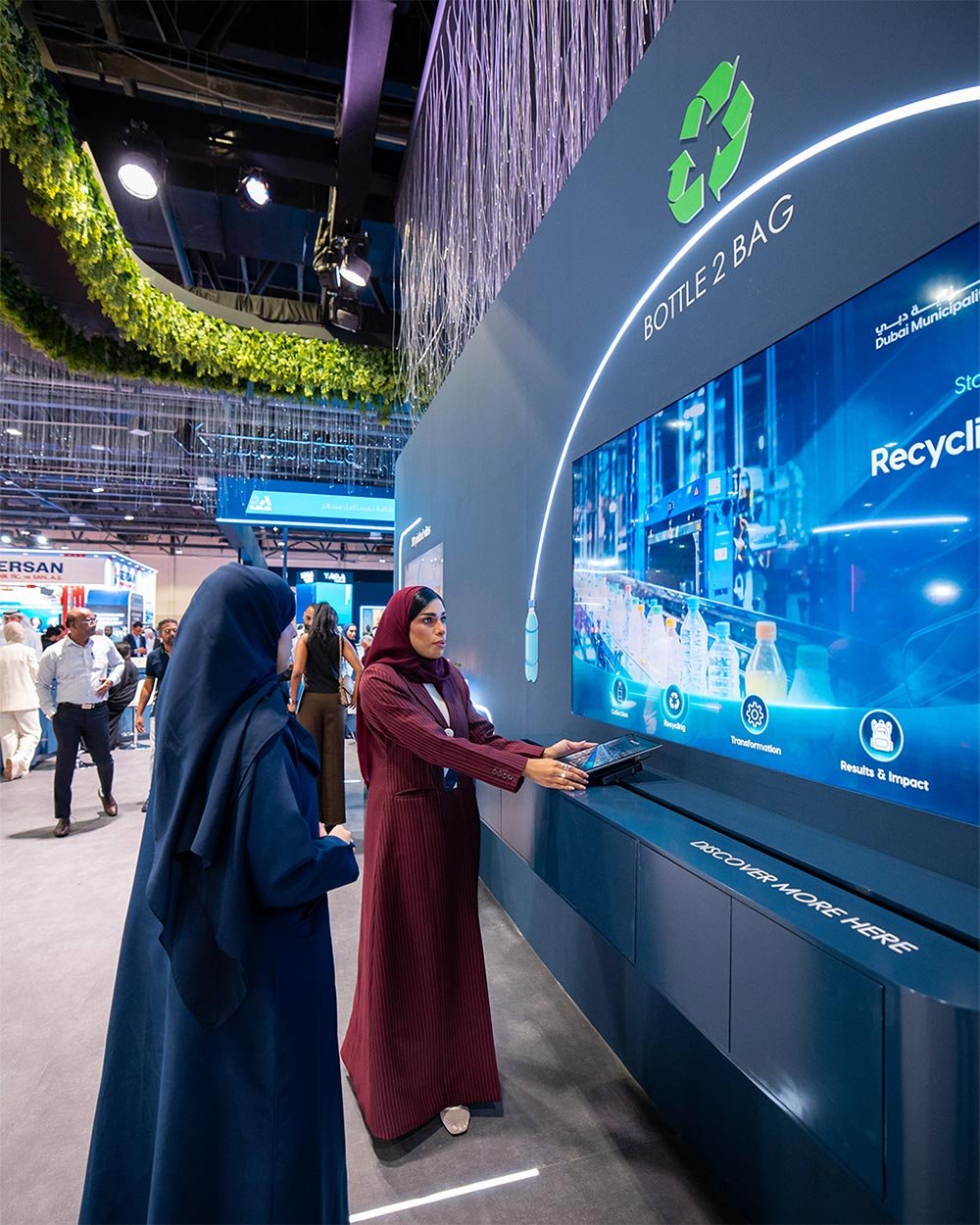
- Projects demonstrate Dubai Municipality's efforts to advance infrastructure sustainability, improve waste management and strengthen public health and safety.
- Waste Generator Platform enhances oversight of waste management activities, while Bottle2Bag initiative transforms discarded plastic bottles into school bags.
- Building Materials Passport Platform supports resource efficiency and circularity throughout the lifecycle of construction materials.
- Dubai Municipality showcases plans to construct the world's first villa using robotic construction systems.
- AI-powered Health and Safety Radar integrates geographic information systems and spatial analysis to support proactive risk monitoring and more efficient inspections.
Dubai, United Arab Emirates, 20 October 2026: Dubai Municipality is showcasing a portfolio of projects advancing sustainable infrastructure, integrated waste management, construction innovation and public health and safety at the 28th edition of the Water, Energy, Technology and Environment Exhibition (WETEX 2026), taking place from 20 to 22 October at Dubai World Trade Centre.
The Municipality's participation highlights its continued efforts to strengthen infrastructure resilience, improve resource efficiency and advance circular economy practices through innovative technologies and integrated management systems. The projects also demonstrate how digital platforms, artificial intelligence and data-driven solutions are being applied to enhance regulatory oversight, construction practices and public safety across Dubai.
These initiatives support the Emirate's wider sustainability objectives, including the transition towards cleaner energy, more efficient resource management and the development of resilient urban infrastructure that responds to future environmental and development needs.
Eng. Adel Mohammed Al Marzouqi, CEO of the Waste and Sewerage Agency at Dubai Municipality, said: "Our participation in WETEX reflects Dubai Municipality's commitment to developing more resilient and sustainable infrastructure through integrated planning, innovative technologies and the efficient management of resources. We are advancing projects that strengthen the governance of waste management, create opportunities to recover and reuse valuable materials, and enhance the capacity of essential infrastructure to respond to Dubai's continued urban growth and environmental challenges.”
He added: "These efforts form part of our wider approach to building an efficient and sustainable infrastructure ecosystem that supports the circular economy, reduces environmental impact and delivers long-term value for the city. They also contribute to the objectives of the Dubai Clean Energy Strategy 2050, Dubai Integrated Waste Management Strategy 2021–2041 and UAE Circular Economy Policy 2031."
Waste Generator Platform
Dubai Municipality is showcasing the Waste Generator Platform, a digital solution designed to strengthen governance, transparency and regulatory oversight across Dubai's waste management sector.
The platform enables authorised waste transportation companies operating in the Emirate to register their contracts with waste generators through a unified digital system. The information captured includes facility locations and activities, types of waste generated, and the number and capacity of waste containers.
By consolidating this information into a comprehensive database, the platform helps standardise contracting procedures, improve compliance monitoring and provide greater visibility into waste management activities across Dubai.
An interactive dashboard gives decision-makers access to accurate, real-time information, supporting more effective planning, regulatory oversight and data-driven decision-making. A dedicated team within Dubai Municipality's Waste Operations Department oversees data registration, verification and analysis to maintain the accuracy and reliability of the information.
Bottle2Bag initiative
The Bottle2Bag initiative demonstrates how recycling can generate environmental and social value by transforming discarded plastic bottles into school bags.
The initiative encourages the recovery and reuse of plastic materials while raising community awareness of responsible consumption and the value of recyclable resources. It supports the Dubai Integrated Waste Management Strategy 2021–2041, which targets diverting 100% of waste from landfills, including recycling 50% of waste.
Bottle2Bag is supported by an extensive collection network comprising smart collection devices at educational institutions, 11 reverse vending machines at Dubai Municipality and partner facilities, 20 dedicated collection containers at public beaches and 13 recyclable material collection centres in residential areas, known as Smart Sustainability Oases.
Through the initiative, Dubai Municipality has collected and recycled two million plastic bottles, equivalent to approximately 40 tonnes of plastic, with more than 90 entities participating in its environmental and social responsibility activities.
In addition to converting discarded bottles into useful products, the initiative contributes to reducing greenhouse gas emissions and energy consumption compared with producing plastic from virgin raw materials, while encouraging wider participation in recycling and circular economy practices.
Circle Dubai
Dubai Municipality is also showcasing Circle Dubai, an initiative to reduce waste generation, increase recycling and improve waste management practices across the emirate. The initiative promotes community participation and behavioural change to encourage more sustainable waste management and advance the circular economy.
Circle Dubai forms part of a comprehensive transformation programme extending beyond 2041, with the ambition of reducing waste generation and achieving 100% waste segregation at source across all residential areas in Dubai. It aims to establish more sustainable waste management practices by encouraging greater participation from households and communities.
The initiative also includes integrated awareness and educational campaigns, supported by specialised teams and innovative communication tools, to promote the principles of ‘Zero Waste’ and encourage responsible waste management practices. These efforts contribute to Dubai’s broader sustainability objectives and its ambition to become a global leader in sustainable resource management.
Tasreef Programme
Dubai Municipality is also highlighting the Tasreef Programme, a major strategic infrastructure initiative launched in 2024 to develop and expand Dubai's stormwater drainage network.
With a total investment of AED 30 billion, the programme aims to increase the network's drainage capacity by 700%, enabling it to accommodate more than 20 million cubic metres of stormwater per day.
Scheduled for completion in 2033, Tasreef will strengthen Dubai's preparedness for extreme weather conditions and future climate challenges, enhance the resilience and sustainability of its drainage infrastructure, and contribute to protecting lives, property and essential urban assets.
Building Materials Passport Platform
As part of its efforts to advance sustainability in the construction sector, Dubai Municipality is showcasing the Building Materials Passport Platform, which provides a structured digital record of construction material specifications and relevant information throughout their lifecycle.
The platform covers the different stages of material use, from design, production, transportation and installation to processing, dismantling, reuse and end-of-life management.
By improving the availability and traceability of material information, the platform supports more informed decisions on material selection, recovery and reuse. It also creates opportunities to increase the use of recycled construction materials, reduce the carbon footprint of building projects and advance circular economy practices within the sector.
Villa construction using robotic systems
Dubai Municipality is presenting plans to develop what it describes as the world's first villa built using robotic construction systems, through a consortium bringing together local and international expertise in advanced construction technologies.
Led by Dubai Municipality, the consortium includes more than 25 specialised companies, alongside local and international universities and research centres.
The project aims to demonstrate the practical application of robotic technologies in residential construction, exploring opportunities to improve productivity, construction quality, resource efficiency and sustainability.
It will be implemented through an eight-month innovation challenge, followed by a further two months dedicated to documenting and evaluating the results.
The construction site will serve as a living laboratory for testing robotic construction technologies under practical conditions, facilitating applied research, technical evaluation and knowledge exchange between participating companies and academic institutions.
The project forms part of Dubai Municipality's wider efforts to support the adoption of advanced construction methods and establish Dubai as a centre for testing and developing innovative building solutions.
Health and Safety Radar
Dubai Municipality is also showcasing Health and Safety Radar, an intelligent monitoring platform that integrates artificial intelligence (AI), geographic information systems (GIS) and spatial analysis to strengthen proactive risk monitoring and improve the efficiency of health and safety inspections.
The platform is designed to identify, assess and monitor potential risks across the Emirate, including those associated with water and air systems and other factors that may affect public health and safety.
By combining spatial information with intelligent analysis, Health and Safety Radar provides indicators that help inspection teams assess conditions across different locations and facilities, identify potential areas of concern and prioritise field inspections.
The system also supports faster assessment and response to health-related reports and notifications, enabling resources to be directed towards locations requiring greater attention.
Interactive maps and smart dashboards provide a comprehensive spatial overview of potential risks, supporting more informed decisions and improving coordination between inspection teams and relevant stakeholders.
The platform also strengthens collaboration with strategic partners in risk management, contributing to more proactive public health and safety oversight across Dubai.
Through its participation in WETEX 2026, Dubai Municipality is demonstrating how investments in infrastructure, digital technologies and innovative development practices can support more efficient municipal services, responsible resource management and long-term urban sustainability.
These projects reflect the Municipality's continued efforts to enhance Dubai's infrastructure capabilities while advancing the environmental, economic and quality-of-life objectives that guide the Emirate's development.