
Middle East tourism set for strong growth as ATM Travel Trends Report forecasts 57% rise in international visitor spend by 2030
● ATM Travel Trends Report 2026 forecasts international visitor spending in the Middle East will increase by US$116 billion, or 57%, between 2025 and 2030
● International travel across MENASA is forecast to rebound by 17% in 2027, more than twice the projected global growth rate of 8%
● Long-haul markets are expected to drive future growth, with leisure nights from China to the Middle East forecast to increase by 160% by 2030
Dubai, United Arab Emirates, 16 September 2026: International visitor spending in the Middle East is forecast to increase by US$116 billion, or 57%, between 2025 and 2030, according to the newly unveiled ATM Travel Trends Report 2026, produced by Arabian Travel Market in association with Tourism Economics, an Oxford Economics company.
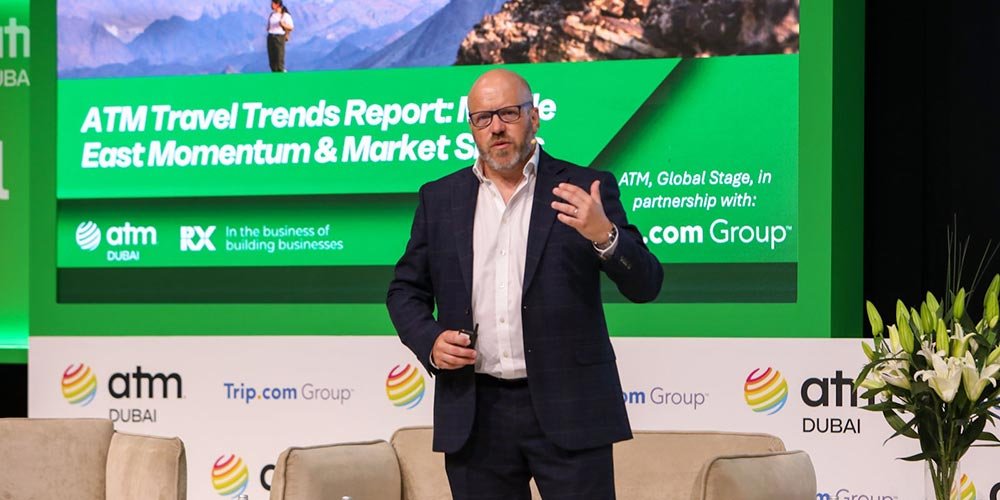
Dave Goodger, Managing Director EMEA, Tourism Economics, presented the findings during ATM Annual Trends Report: Middle East Momentum & Market Shifts on the Global Stage at ATM 2026, taking place at Dubai World Trade Centre until Thursday 17 September.
According to the report, global travel reached record levels in 2025, with total visitor nights reaching 24 billion, 16% above 2019 levels, while in-destination spending increased by 26% compared with 2019 to US$7.2 trillion. International arrivals also exceeded 1.5 billion for the first time.
The Middle East, North Africa and South Asia (MENASA) region has been a major contributor to this growth. Total travel volumes across MENASA in 2025 were almost 50% above 2019 levels, three times the growth recorded globally, while the region generated more than half of the worldwide increase in international travel over the same period.
While geopolitical disruption is expected to impact Middle East travel during 2026, Tourism Economics forecasts a strong rebound in 2027. International travel is expected to grow by 8% globally next year, compared with 17% across MENASA. The research also shows that recovery periods following major travel disruptions have shortened significantly, from approximately 24 months in the early 2000s to around 10–12 months in recent years.
By 2030, international travel across MENASA is forecast to reach 316 million arrivals and 2.3 billion visitor nights, generating US$408 billion in spending, representing increases of 36%, 46% and 55%, respectively, compared with 2025.
Speaking during the session, Goodger said: “We are indeed optimistic about growth. Over the next five years we see travel expanding on a structural basis rather than just a cyclical rebound. International travel has never mattered more, 2026 is building on a record 2025, and MENASA is outpacing the world.
“This year is disrupted by an uncertain economic and geopolitical backdrop, but consumers are treating travel as essential. People are prioritising experiences over things, and that, combined with favourable demographics, rising wealth and sustained investment in capacity, underpins our confidence in the region’s long-term momentum.”
Technology is also playing a growing role in the region’s travel industry. According to research cited in the report, 91% of Middle East travel businesses are piloting or operating AI within their organisations, with 85% reporting measurable cost savings. Prospective visitors to the Middle East are also more than twice as likely to have used an AI chatbot to plan a trip, at 28% compared with 12% among travellers interested in other regions.
Following the presentation, the Travel Trends Panel: Why Travel Will Win in the Middle East, featuring Eddy Tannous, Chief Operating Officer, Rotana Hotel Management Corporation PJSC, and Tarik Fadil, Vice President of Supply, Agoda, alongside Goodger, discussed the factors supporting the region’s continued tourism expansion.
Commenting on the Middle East’s capacity for further growth, Tannous said: “I find the growth discussion very interesting. In 2008, the market changed drastically. We went into a recession, and everyone was asking: Is this it? Have we reached maximum capacity? At the time, Dubai had around 45,000 keys; today it’s closer to 160–170,000 keys.
“We’re hearing a similar story now in Abu Dhabi, which is at around 55,000 keys: Are we at full capacity or not? Personally, I don’t like comparing ourselves to what we were five or ten years ago. I prefer to compare the Middle East to major cities around the world. Dubai has seen substantial growth over the last 10–20 years, but the region’s potential is still far bigger than we think.”
Fadil highlighted the Middle East’s dual role as a major tourism destination and international connectivity hub, as well as the importance of AI and localisation in serving increasingly diverse traveller markets.
He said: “The Middle East is two things at once: a destination in its own right and a hub connecting Asia, Europe and Africa. Serving it well comes down to leveraging AI and deepening localisation. Delivering an AI-powered travel experience will help sharpen every step of the journey, from pre-booking inspiration to post-booking support. We want the customer to have a local experience when they book with Agoda, no matter where they’re from.”
Danielle Curtis, Regional Portfolio Director – UAE, RX Global, said: “The findings presented at ATM demonstrate the strength of the Middle East’s long-term tourism opportunity. Bringing research and industry perspectives together on the Global Stage gives our community valuable insight into where demand is moving and the opportunities that will shape the sector’s future.”
Now in its 33rd edition, Arabian Travel Market remains the leading international travel and tourism event in the Middle East, bringing together the global travel community to develop partnerships, share knowledge and explore new business opportunities across the sector.