
Qualifiers Prepare for Final Qualifying Heats on November 1
Dubai – October 2026:
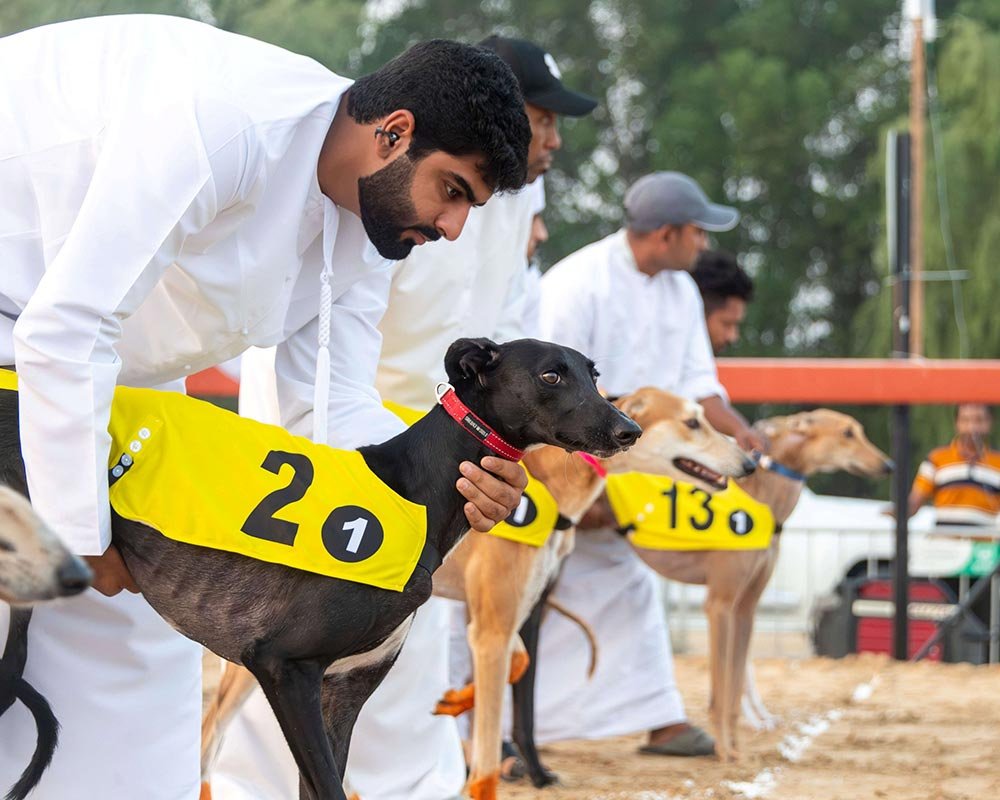
The Saluki Championship has concluded the first stage of the qualifying heats for its 20th edition following highly competitive races held at Al Marmoom tracks, where closely matched times and an impressive level of performance highlighted the intensity of the competition.
The first stage determined the salukis advancing to the second stage of the qualifiers — the Final Qualifying Heats, scheduled for November 1 — as the championship marks two decades among the region’s leading heritage competitions, attracting enthusiasts of the traditional sport from across the UAE and the wider region.
Organized by the Fazza Championships Department at the Hamdan Bin Mohammed Heritage Center, the championship attracted strong participation from across the UAE, alongside a large audience that followed the eight heats contested across the Professionals, Owners and Amateurs categories.
The 2,000-metre races were held for both male and female salukis, with the top finishers from each heat advancing to the Final Qualifying Heats, which will in turn determine those progressing to the championship’s final stage.
## *Two Decades of Competition*
The 20th edition represents a significant milestone in the history of the Saluki Championship, which has completed two decades of competition while maintaining its position among the UAE’s prominent heritage sports.
Over the years, the championship has attracted successive generations of professionals, owners and amateurs, while continually evolving in terms of organization and technical standards and expanding the base of participation and interest in a sport deeply rooted in the history and culture of the region.
The championship’s continuity over 20 years reflects the enduring significance of saluki racing, a sport historically associated with desert life and traditional hunting skills. Over time, it has evolved into an organized competitive sport based on speed, physical ability and high standards of preparation, while retaining its historical character and its established place within the UAE’s heritage sports.
Close Times Intensify Competition
The first stage of the qualifying heats showcased an advanced level of competition, reflected in the closely matched times recorded by participating salukis across the various categories.
Competition for places in the second stage was particularly intense, highlighting the importance of thorough preparation and physical readiness in determining results, especially amid a high level of competition between experienced participants and those seeking to establish themselves in the championship.
Both the male and female competitions produced strong performances, with new contenders successfully matching the standards set by more experienced participants. This added further excitement to the heats and reflected the continued development of training methods, saluki care and the growing emphasis on enhancing their physical condition and competitive capabilities.
The inclusion of three distinct categories — Professionals, Owners and Amateurs — also added an important dimension to the championship by allowing participants of different levels to compete within approved classifications. This enhances competitive fairness, broadens opportunities for participation and gives the championship a more diverse base of practitioners and enthusiasts.
Twenty Years of Development
Rashid Hareb Al Khasouni, Director of the Fazza Championships Department at the Hamdan Bin Mohammed Heritage Center, said that reaching the championship’s 20th edition represents an important milestone and reflects the success of efforts made over two decades to develop the sport and strengthen its presence among participants.
He noted that the true value of this achievement lies in maintaining the championship’s continuity and its ability to attract new participants alongside experienced competitors who have contributed to establishing its position over the years.
Al Khasouni said: “Twenty years of competition give us an important opportunity today to assess what has been achieved and build upon it. Heritage sports require continuous efforts to ensure their development according to clear technical and organizational standards, while providing younger generations with genuine opportunities to practise them.
“The advanced performances and closely matched times we witnessed during the first stage of the qualifying heats confirm that the championship is moving in the right direction and that growing interest in the sport is directly reflected in the quality of performance and the increasingly competitive standards.”
Al Khasouni added: “At the Fazza Championships Department, we are committed to ensuring that every edition represents a genuine addition to the championship’s journey, whether through developing organizational procedures, enhancing the quality of competition or providing an appropriate competitive environment for all categories.
“We also place particular emphasis on the Owners and Amateurs categories because of their important role in expanding the participation base and providing more enthusiasts with an opportunity to enter the sport. We look forward to seeing strong competition in the Final Qualifying Heats that builds on the performances delivered during the first stage. We also want the 20th edition to be an occasion to celebrate the championship’s history and recognize the owners and participants whose efforts have played the greatest role in its continuity and development.”
The Decisive Qualifying Stage
With the list of qualifiers from the first stage now complete, attention turns to Al Marmoom tracks, which will host the Final Qualifying Heats on November 1.
The competition will bring together the leading salukis that successfully advanced through the first round of qualifiers as they seek to secure their places in the championship’s final stage.
This phase represents a crucial point in the championship, as it will determine who advances to the finals. Strong competition is expected across all categories, particularly given the narrow margins in times recorded during the opening heats and the high levels of readiness and competitive ability demonstrated by participants.