
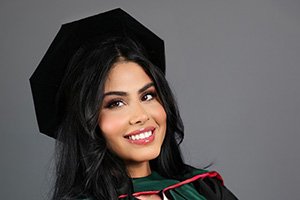
The Lebanese graduate of St. George's University School of Medicine reflects on the experiences that shaped her path to a family medicine residency in the United States
For Dr. Julia Ali Kobeissi, a childhood experience with malaria sparked a lasting interest in medicine and the difference timely care can make. Growing up in Lebanon, she developed a commitment to helping patients access care and better understand their health, a purpose that now guides her journey into family medicine.
Born in Lebanon, Dr. Kobeissi completed a Bachelor of Science in Biology at the American University of Beirut. Her interest in science was matched by a desire to understand patients beyond their symptoms.
"My experiences with malaria made me aware of the consequences of healthcare disparities from an early age," she says. "They inspired my commitment to medicine and to serving communities where access to care and health education can make a significant difference."
That commitment eventually led her to St. George's University (SGU) School of Medicine in Grenada, West Indies. She began her medical education through the Keith B. Taylor Global Scholars Program at Northumbria University in Newcastle, United Kingdom, before continuing her Basic Sciences training in Grenada.
"SGU offered a path that combined strong academics with international experience," Dr. Kobeissi says. "Beginning in Newcastle offered a smaller class setting, while Grenada introduced me to a diverse medical community."
The curriculum built her scientific foundation and supported her preparation for the United States Medical Licensing Examination (USMLE), while practical teaching helped connect medical knowledge with patient communication and examination skills.
Outside the classroom, Dr. Kobeissi supported women's health and represented student concerns through Women in Medicine and the Student Government Association. She also participated in community screenings and health education activities in Grenada.
Dr. Kobeissi completed clinical rotations across several New York hospital systems, gaining experience with diverse patient populations and a broad range of medical conditions.
"Clinical rotations were where the knowledge from Basic Sciences began to make sense at the bedside," she says. "I learned to stay present, ask questions, understand the reasoning behind clinical decisions, and treat every patient with dignity during vulnerable moments."
The specialties she encountered ultimately drew her to family medicine. She valued the continuity family physicians build with patients and the opportunity to work across preventive care, acute illness, chronic disease, and mental health.
In 2026, Dr. Kobeissi matched into a family medicine residency at University of Vermont Champlain Valley Physicians Hospital. The result marked the end of a demanding application process and the beginning of the career she had worked towards for years.
"Matching was both a relief and a confirmation that the long nights, examinations, and challenges had been worth it," she says. "It brought me one step closer to becoming the physician patients can turn to when they are frightened, in pain, or looking for answers."
As she begins residency, Dr. Kobeissi hopes to promote preventive care and help patients make informed decisions, particularly those historically underserved or overlooked by healthcare systems.
Her advice to aspiring medical students in Lebanon is practical: ask questions, study consistently, seek feedback, and find mentors early. "Medicine is deeply meaningful work," she says. "Success depends on resilience, curiosity, and taking responsibility for your learning."
Her journey from Beirut to Grenada, the United Kingdom and the United States reflects the international path SGU offers students seeking medical training and the opportunity to serve diverse communities around the world.